
Create a Profit Engine—

Build the Culture Your Competitors

Can’t Copy.

Start Here
Two employees sitting at a conference room table engaged in a positive discussion in front of computer.  Employee retention Houston HR consulting

HR Consulting in Houston: HR Services That Work

Are your HR strategies fueling a culture that drives real business growth — or just managing the status quo? The truth is, tactics can only take you so far. Sustainable growth and profitability come from a high-performance culture where people know what winning looks like and feel empowered to make it happen.


But a high-performance organizational culture doesn’t happen by accident. It’s built through effective leadership, strategic HR practices, and a commitment to open communication. At HR Strategies Now, we help organizations turn culture into a competitive advantage that powers engagement, accountability, and results.


The right HR strategies and practices will build the culture that you're after, improving your ability to attract, engage, motivate and retain the top talent you need to grow.  This is HR consulting done right.  This is HR Strategies Now.

Learn More

The Full HR Life Cycle Approach

Have you ever wondered how your company is going to attract, engage and retain the highest performing employees? For many business leaders, that’s one of their greatest challenges. That's why it's important to focus on the full HR life cycle.
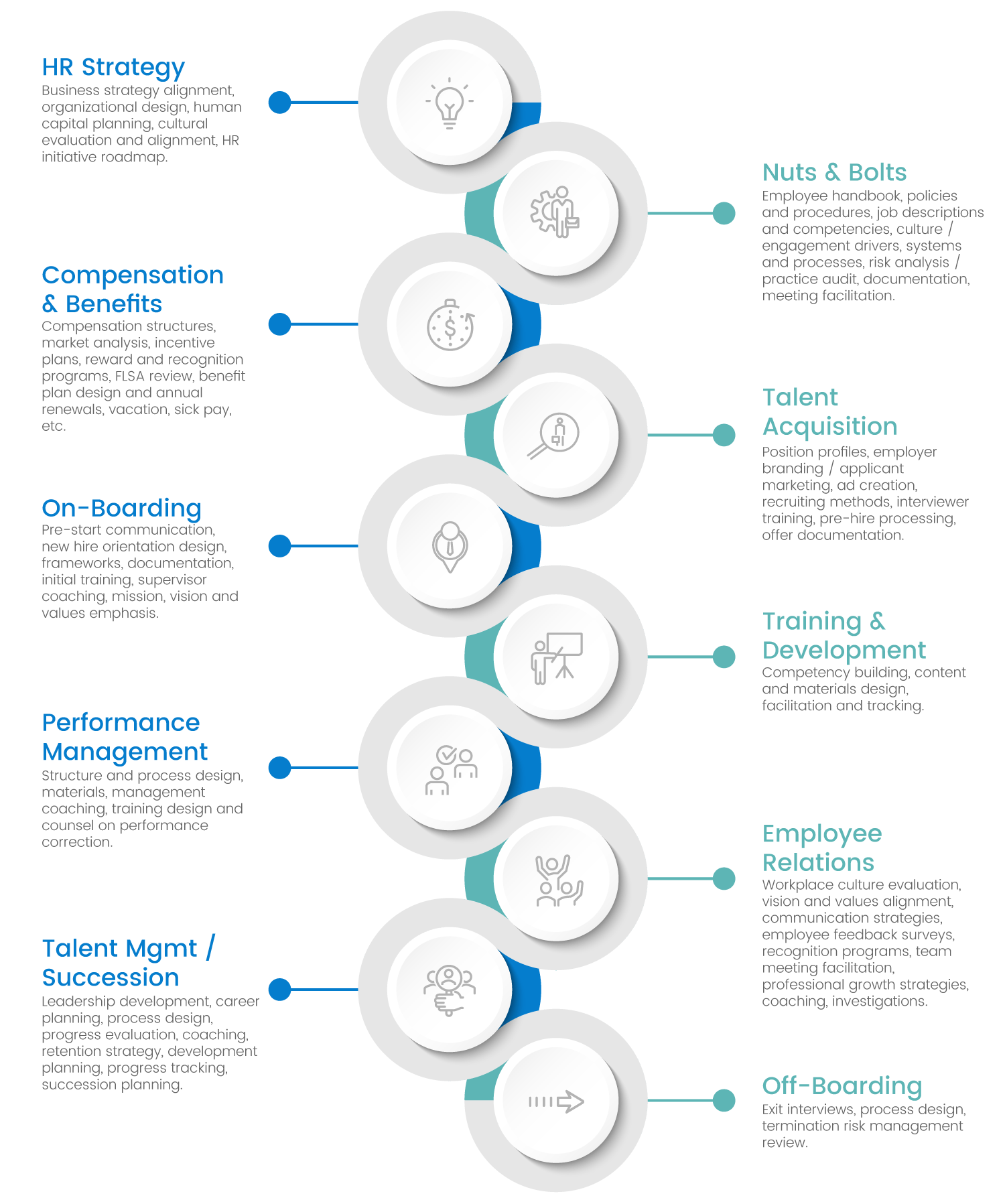
A grey, blue, and green graphic containing icons illustrating the full HR lifecycle including HR Strategy, Nuts & Bolts, Compensation & Benefits, Talent Acquisition, On-Boarding, Training & Development, Performance Management, Employee Relations, Talent Management, and Off-Boarding
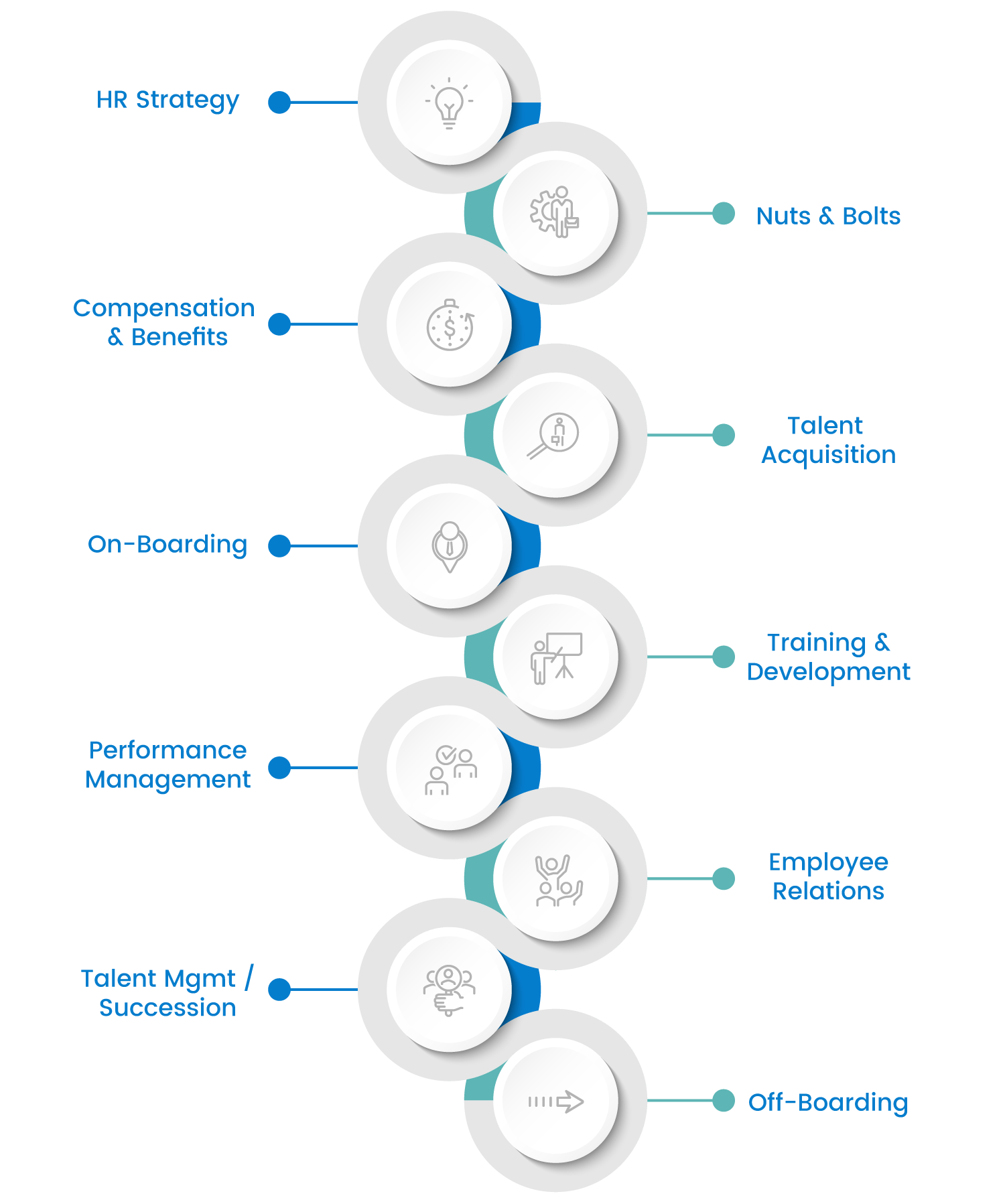
Series of icons shown vertically describing the full HR lifecycle that HR Strategies Now covers including strategy development, foundational practices, compensation and benefits, talent acquisition, onboarding, training and development, performance management, employee relations, and talent development.

We deliver HR consulting for small and mid-sized businesses seeking to build a high performance leadership team and a results-driven culture. Our work helps you attract, engage, motivate, and retain top talent, reduce turnover, and strengthen your workplace culture. Whether you need performance management training, talent acquisition services, or leadership development, we partner with you across the full HR life cycle to build systems that scale your business.

How Do You Know if HR Strategies Now is Right for You? 

  • Do you want an organizational culture focused on growth?
  • Are you looking for a skilled partner in your HR journey rather than a slick web platform?
  • Do you need real world guidance on the full HR life cycle - or a part of it?
  • Are you looking for more depth on HR practices that can really help your business grow?
  • Do you place a high value on trust-focused business relationships?
  • Do you believe there is significant work that needs to be done but don’t have the budget for a full time HR Manager?
  • Are you looking for greater alignment and cohesion within your team?


If you said yes to any of these, let’s get started! Contact HR Strategies Now for expert HR consulting in Houston.

Call Now

Latest News

By Brian Wallace April 29, 2026
From Theory to Execution - Building a Culture That Demands Leadership If leadership excellence isn’t about knowledge, then what is it about? It’s about building an environment where leadership is required, visible, and unavoidable. Most organizations never get there. Here’s how the ones that do think differently. Step 1: Define Leadership in Behavioral Terms “Be a better leader” is meaningless. Instead, define leadership like this: “Addresses performance issues within 48 hours” “Delegates decisions with clear ownership and authority” “Drives clarity by aligning team priorities weekly” If you can’t see it, you can’t manage it. Step 2: Make Leadership Measurable What gets measured gets managed. Ask: Are decisions being pushed down or pulled up? Are leaders developing successors or creating dependency? Is accountability consistent across teams? Are new ideas being generated? If leadership isn’t measured, it becomes subjective - and subjective standards don’t scale. Step 3: Align Consequences with Expectations This is where most organizations fail. They say leadership matters, but they tolerate: avoidance of difficult conversations inconsistent accountability leaders who produce results but damage culture siloed and self-optimizing behavior You can’t have leadership excellence without consequences for non-leadership behavior . Step 4: Build Leadership into the Operating System Leadership isn’t a program. It’s how the business runs. It shows up in: how meetings are conducted how decisions are made how performance is reviewed how feedback is delivered If leadership only shows up in training sessions, it won’t stick. Step 5: Create Cultural Pressure for Leadership The strongest cultures don’t rely on top-down enforcement. They create peer-level expectations. Leaders hold each other accountable, teams expect clarity and ownership, and underperformance is addressed quickly and directly Leadership becomes the norm, rather than the exception. The Payoff When leadership becomes part of the system, execution speeds up, decision-making improves, teams take ownership, and senior leaders get out of the weeds. And the organization finally operates at the level its strategy demands. Final Thought Most companies are trying to teach leadership. The best companies build environments where leadership is the only way to succeed . That’s the shift. And once it happens, everything else gets easier.
By Brian Wallace April 29, 2026
Let’s address the uncomfortable truth: Most leaders already know what they should be doing. They just don’t do it consistently. Not because they’re incapable - but because something is working against them. What’s Really Holding Leaders Back? It’s not a lack of awareness. It’s a combination of three forces that quietly shape behavior: 1. Success Has Trained Them to Stay the Same Leaders are promoted because they deliver results. So they double down on what got them there: solving problems themselves moving quickly by making decisions solo stepping in when things go sideways The problem? Those behaviors don’t scale. But letting go of them feels risky. So they don’t. 2. Short-Term Pressure Overrides Long-Term Discipline In theory, leaders know they should: coach instead of direct develop instead of fix empower instead of control But in reality? Deadlines hit. Clients escalate. Revenue matters. So they revert to speed and control because it’s faster right now. And just like that, long-term leadership development loses to short-term execution pressure. 3. The Organization Quietly Rewards the Wrong Behavior Watch closely and you’ll see it - the leader who “jumps in and saves the day” gets praised. Or the leader who builds a self-sufficient team gets overlooked. Or perhaps the leader who avoids conflict keeps the peace and avoids backlash. Organizations say they want leadership excellence. But their reward systems often reinforce the opposite. Why This Matters More Than You Think When leaders don’t change: their teams don’t grow decision-making stays centralized innovation slows burnout increases at the top And eventually, the business hits a ceiling that no strategy can fix. The Real Work of Leadership Development If you want leaders to change, you have to change the environment around them. That means: redefining what “good leadership” looks like aligning incentives with the behaviors you want creating consequences for avoiding leadership responsibilities Because people don’t rise to expectations. They rise to what the system reinforces .
Executive team sitting around a conference table.
By Brian Wallace April 29, 2026
Most companies don’t lack leadership knowledge—they lack execution. Discover why leadership fails and what it takes to turn insight into results.
Show More